


CFO GROUP INTEGRATED SERVICES
Will AI Take Over the World? Separating Fear From Reality in 2026
CMO Media Lab Pte Ltd • December 2, 2025
Introduction: Beyond the Sci-Fi Scares of Artificial Intelligence
The question “will AI take over the world?” has moved from science fiction into everyday conversations. You hear it in boardrooms, schools, tech forums, and even in New York Times headlines. Businesses, governments, and the public are increasingly concerned about how artificial intelligence (AI technology) will shape the future of work, society, and daily life.
Headlines often suggest a dramatic AI takeover, in which powerful AI systems replace human labor, automate jobs, or even gain control of the world. But much of this worry is fueled by movies—not by the actual reality of today’s AI models and AI tools.
This article cuts through the noise to explain AI’s abilities, limitations, and the real risks we should focus on.
Why People Fear an AI Takeover
The Media Problem: How AI Takes Over Headlines, Not the World
Online content, viral videos, and news articles often exaggerate AI’s capabilities and paint extreme scenarios in which machines “take over the world.” Stories about superintelligent AI, autonomous vehicles, or AI that can persuade humans activate fear and trigger alarm bells for most people.
This creates confusion between what:
- AI models can realistically do today
- People imagine AI could do
- and what computer science professors, researchers, and safety experts are actually worried about
The exaggeration makes the idea of an AI takeover feel more real than it is.
Deconstructing the AI Takeover Narrative
Fiction Makes Artificial Intelligence Look Alive—But It Isn’t
Movies like The Terminator and Ex Machina make AI look conscious, emotional, and capable of plotting against humans. These stories amplify the idea of losing control over something we create.
But real AI systems today—even advanced generative AI—do NOT have:
- emotions
- intentions
- self-awareness
- independent goals
AI outputs are generated from training data, mathematical rules, and statistical predictions—not personal desires.
Why Current AI Cannot “Take Over the World.”
| What Today's Narrow AI Can Do | What AI Would Need to Take Over the World |
|---|---|
| Data analysis | Independent agency |
| Content creation | General intelligence |
| Image recognition | Ability to act across multiple domains |
| Predicting patterns | Freedom from human oversight |
No existing AI system or AI agents meet these requirements. Even the most advanced AI models operate within strict boundaries defined by developers and the data they use.
What AI Can Do: Real Capabilities & Global Impact
AI Tools Are Powerful—But Not Sentient
Modern AI is reshaping industries through machine learning, generative AI, and automation. Examples include:
- Robotic surgery improving precision
- AI art transforming creativity
- AI-generated content for business and media
- Legal research powered by AI
- AI agents automating customer support
- Data entry tasks are becoming fully automated
- Research tasks accelerating with AI
This is not a threat to humanity—but a shift in how we work, create, and collaborate with technology.
AI and the Job Market: A New Workforce Reality
AI’s most significant impact is economic. It is transforming the job market by:
- eliminating repetitive jobs
- creating new jobs in tech and AI development
- requiring reskilling for millions of workers
- restructuring entire industries
This shift has profound implications. If people cannot transition quickly enough, it could contribute to widening inequality or even localised economic crises.
The real risk isn’t that AI takes over the world—it’s that businesses and company leaders fail to prepare workers for the changes ahead.
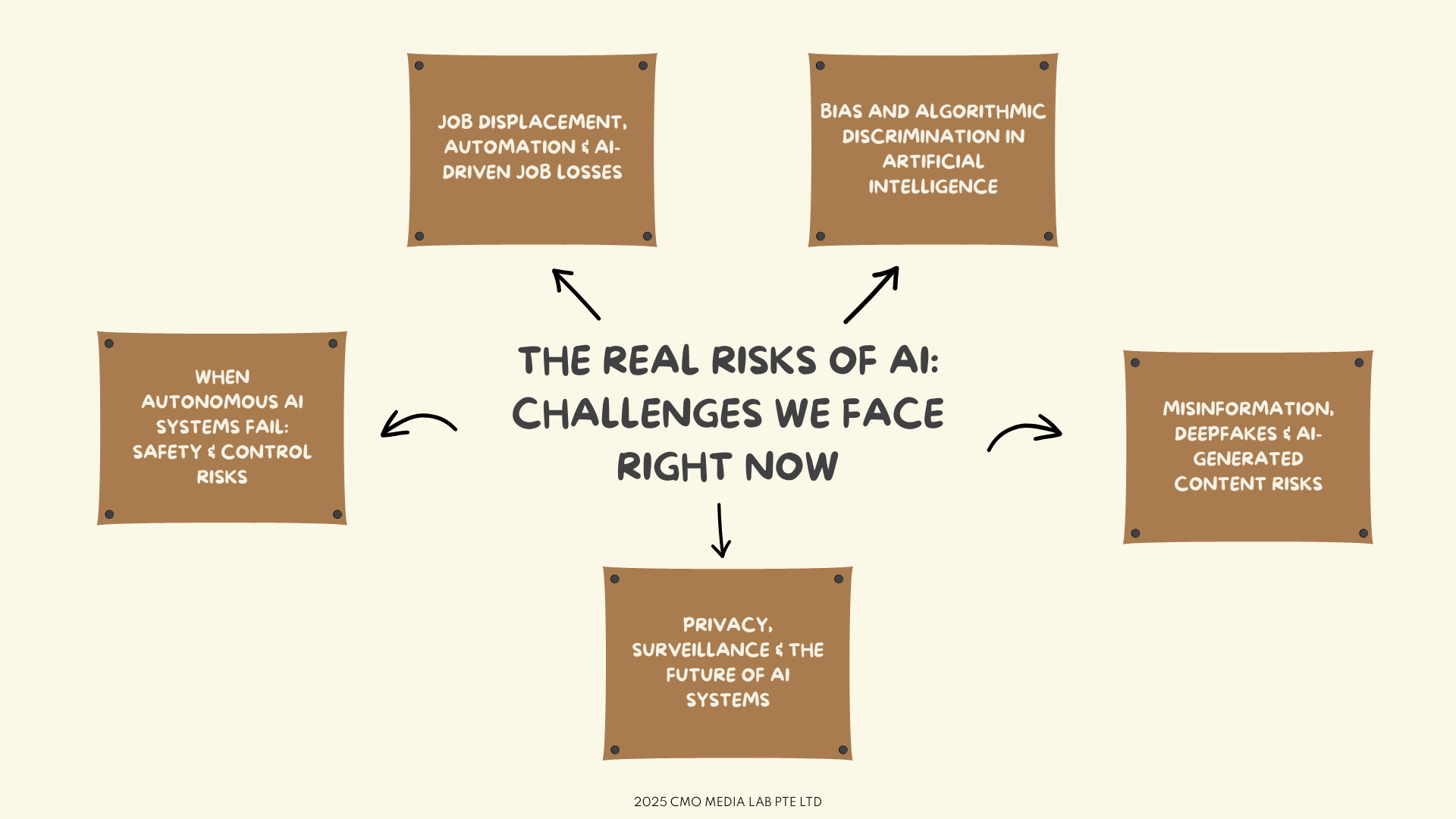
The Real Risks of AI: Challenges We Face Right Now
1. Job Displacement, Automation & AI-Driven Job Losses
Automation is reducing the need for human roles in manufacturing, customer service, administration, and more. Without proper support, job losses may grow faster than new opportunities.
2. Bias and Algorithmic Discrimination in Artificial Intelligence
AI learns from training data, which often includes biases.
This affects:
- hiring decisions
- policing systems
- financial approvals
- healthcare access
Without intervention, AI could unintentionally amplify discrimination.
3. Misinformation, Deepfakes & AI-Generated Content Risks
AI-generated content can:
- impersonate individuals
- spread fake news
- manipulate public opinion
- influence elections
As
AI tools improve, misinformation becomes harder to detect—putting society at risk.
4. Privacy, Surveillance & the Future of AI Systems
AI depends heavily on data, and the more powerful the model, the more data it requires. This raises issues such as:
- mass surveillance
- lack of consent
- unclear data ownership
- intrusive monitoring in the workplace
Without regulation, these risks will continue to grow.
5. When Autonomous AI Systems Fail: Safety & Control Risks
More powerful AI-driven technologies mean higher stakes. Risks include:
- faulty autonomous vehicles
- unpredictable AI agents
- financial trading errors
- autonomous weapons malfunctioning
These are real risks—not fictional ones.
Future Risks: Superintelligent AI & Global Competition
The Alignment Problem: Ensuring AI Could Remain Safe
If superintelligent AI or AGI (Artificial General Intelligence) is developed someday, the challenge will be ensuring it aligns with human values. Misalignment can lead to dangerous unintended consequences—even without malicious intent.
The Global Race for AI Dominance: What It Means for the World
Countries are in a race to advance AI. Fast, unsafe development without global rules could lead to:
- risky deployment
- extreme measures
- geopolitical instability
- misuse of AI systems
International cooperation is essential.
| Current AI Risks | Future AI Risks (Superintelligent AI) |
|---|---|
| Bias | Alignment failure |
| Privacy | Loss of control |
| Misinformation | Extreme autonomy |
| Job displacement | Unintended catastrophic outcomes |
The Role of Humans: Shaping Artificial Intelligence Responsibly
Ethical AI Development: Building Systems That Don’t Take Over the World
Developers and governments must prioritize:
- Fairness
- Transparency
- Safe development
- Accountability
Ethics must be part of every stage of AI development—not an afterthought.
Preparing Workers for an AI-Powered Job Market
Workers will need skills AI cannot replace:
- Creativity
- Emotional intelligence
- Critical thinking
- Complex problem-solving
AI will change many jobs, but it will not eliminate the need for humans.
Governance, Policy & Global Cooperation
To protect society, policies should ensure:
- Privacy protections
- AI audits
- Responsible data usage
- Safety standards
- International oversight
Humanity—not AI—must decide the rules.
How AI Technology Is Transforming Marketing: Meta Ads, Google Ads & SEO
AI’s Real Impact on Digital Marketing Today
While some people worry about AI replacing humans, AI technology is already creating growth across business sectors. In digital marketing, AI helps company leaders make smarter decisions and reach better audiences.
Smart Targeting: How AI Takes Meta Ads to the Next Level
Meta uses AI models to:
- Analyze user behavior
- Predict conversions
- Adjust bidding
- Personalize ad delivery
- Evaluate creative performance
This allows businesses to achieve more results with less spend.
AI in Google Ads: Predictive Bidding, Automation & New Jobs in Marketing
Google uses machine learning to:
- Run Performance Max campaigns
- Automate Smart Bidding
- Analyze keyword intent
- Create Responsive Search Ads using AI
Businesses that leverage AI gain an advantage over those who don’t.
AI in SEO: Smarter Search, Smarter Systems, Smarter Competition
AI now influences:
- content ranking
- intent matching
- website quality signals
- spam filtering
- SERP predictions
SEO has become more competitive as AI tools help marketers produce higher-quality content.
Why Businesses Must Adapt: AI Could Reshape Digital Marketing Forever
AI is not replacing marketers—it’s enhancing the best ones. Businesses must:
- Use AI tools
- Build strong creatives
- Develop first-party data
- Stay agile with changing technologies
The real threat isn’t AI—it’s businesses refusing to adapt to it.
AI won't replace marketers. But marketers who use AI will replace those who don't.
Why Partnering With CMO Media Lab Is the Smartest Move You Can Make
At CMO Media Lab, we don’t just run ads — we engineer predictable growth. Businesses choose us because we focus on real results, not vanity metrics. Our strategies combine AI-powered optimization with human creativity, helping your brand win across Google Ads, Meta Ads, and SEO.
We analyze millions of data points, refine your marketing funnel, and build campaigns that perform — no guesswork, no shortcuts. If you want a marketing partner that treats your business like its own and stays ahead of fast-moving AI technology, this is where you should be.
Conclusion: Will AI Take Over the World?
No — AI is not going to take over the world like in movies. It doesn’t think or have intentions. The real risks involve bias, misinformation, job disruption, and unsafe deployment.
AI is powerful — but humans control how it develops and how it is used.
With responsible design and smart regulation, AI can help humanity — not harm it.
AI won’t decide the future. We will.